production
Process Management
High quality & flexibility
through an integrated
framework
Capabilities span single parts to high‑mix, short‑lead‑time mass production.
Key steps and our focus points are outlined below.

Cutting

Crimping

Assembly

Inspection
Quality assurance in every step
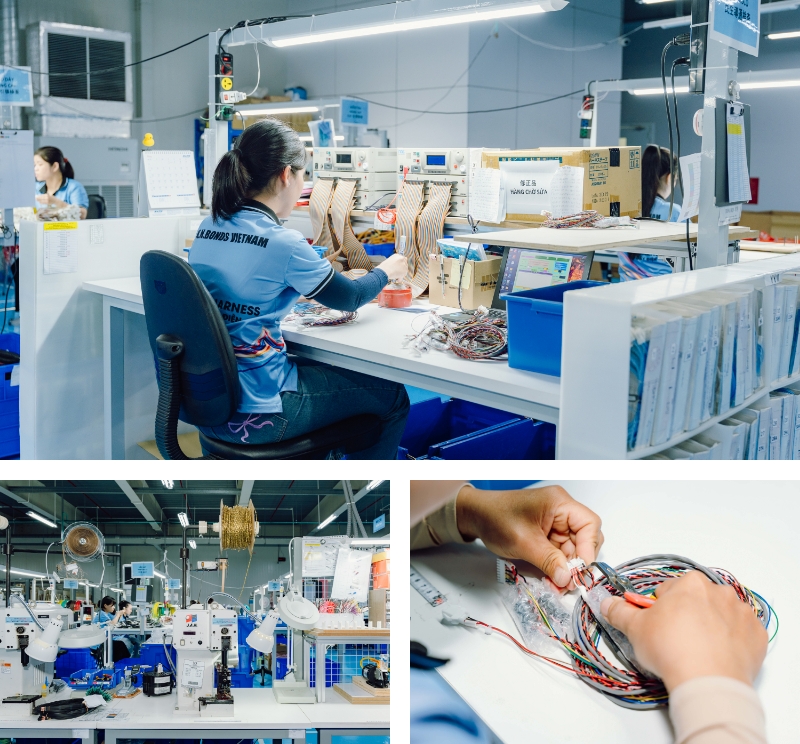
We have accumulated a wealth of knowledge and experience in each stage of the manufacturing process, enabling us to achieve both high quality and efficiency.
The production know-how cultivated over many years by the KOTERA Group in Japan is faithfully applied at our factory in Vietnam.
flow01
Flow 01Cutting
We use automatic cutting machines that can handle extremely thin to extremely thick wires, from AWG30 to 250sq. We also use manual cutting depending on the application and quantity, enabling flexible process design.
All cutting data is linked to the KOTERA management system, helping to prevent errors and losses in length.

flow02
Flow 02Crimping
We use a wide range of equipment, from automatic crimping machines, hydraulic machines, and air crimping machines to hand tools, to accommodate various types of terminals. We manage crimping quality numerically through crimp height measurement and tensile testing, and strive to prevent variation.


Soldering
We use lead-free solder and strictly control the temperature. Specially certified personnel perform specialized tasks such as PCB soldering, joint soldering, and cup soldering to ensure consistent quality. All work records are stored in the system to ensure traceability.

Ultrasonic Welding
Wire joints are bonded by ultrasonic welding.
This process eliminates the risk of crimp defects or insufficient solder.

Assembly (Assy)
In the assembly process, we insert terminals into connectors while checking for clearance, twist wires, bundle them, wrap them with tape, and complete other tasks in accordance with the drawings.
flow03
Flow 03Assembly
Dedicated boards per part number; continuity tests run simultaneously.


Braiding
Nylon braid protects harnesses.
flow04
Flow 04Inspection
We conduct inspections on all parts to ensure that they are manufactured according to the drawings and specifications. We check all terminals for insertion and clearance, and conduct conductivity tests on all parts. Depending on the product characteristics, we also conduct RUCON tests and pressure resistance tests.

Management system sustaining quality & flexibility
At K.N. BONDS, we have established a thorough inspection system, on-site response capabilities, and a centralized management system utilizing IT in order to achieve both Japanese quality and Vietnamese flexibility.
POINT 01
Quality assurance through100%inspection & records
During inspections (and during work), products with past defects are displayed on the monitor to prevent recurrence of defects. If you notice anything unusual or irregular, use an identification card to identify the product as good, and call the manager using the andon system so that the manager can investigate the cause and take appropriate measures. Inspection records are also entered into the core system using the barcode on the work instruction sheet, just like work records. Inspection items and the number of inspection points are registered in the master database for each product code, so the system prevents shipment if any inspections are missed. Specification values are also registered in the master database, so actual measurement values that fall outside the specifications cannot be entered.

POINT 02
On‑site flexibility forsmall lots & short lead times
Shop‑floor adaptability underpins high‑mix, low‑volume work.
Based on a skill map that visualizes the skill levels of all employees using a competency chart, we have established a system that allows for flexible personnel allocation and capacity management for each process, enabling us to handle interruptions without any problems.

POINT 03
Integrated production &inventory control via IT
Barcodes track every stage from parts receipt to shipment.
The data you enter is immediately recorded on our internal server, allowing you to check parts inventory, automatic ordering, work progress, and internal defects in real time.
We have been improving and refining the system developed by Kodera S/S 25 years ago, and it is also useful for preventing mistakes.
Contact Us
Click here for product or
drawing inquiries